On the back of last week's 'main de dieu' cheatery by Thierry Henry on behalf of a desperate French side the sponsors stood firm. No matter how hard hit by the loss of the Emerald pound Henry was their man and Gillete pledged firm faith in his continued ability to persuade men their Mach 4 is the best a man can get.
In the last 24 hours the collective karma of the trio of renowned sports stars who remorselessly and adroitly shape the balls of the sports in which they are champions in the bathrooms of the poor until they agree to upgrade from a Mach 3 have taken a tumble.
Gentlemen, Tiger Woods Roger Federer you guys took one hell of a beating from the unerring law of cause and effect. So whether it's a bit of domestic upset and car frappery or the unsanctified portals of the 02 centre, good fortune avails not when the plucky Irish have been cheated. Amends must be made and the replay must be allowed or else all could be lost...
Saturday, November 28, 2009

Friday, October 2, 2009
Gandhiversary

On Tuesday I attended a very rewarding event on charitable Project Planning at the incomparable Bhavan Centre . Thanks to Wirya and all at CaVSA for an enjoyable day made all that much better for being sat next to Raj Jogia from the Pepperpot Day Centre in Ladbroke Grove.
Before setting off for lunch Raj observed my copy of Wisdom of the Lotus Sutra Volume IV sticking from under my bag. I always find members in seemingly unlikely situations to be one of the great joys of the practice With Raj as my mentor I helped myself to delicious seconds from the canteen. By the time we exchanged details the penny finally dropped that this must be the father of Hiren with whom I enjoyed two years in Dedicated Soka.
This coming hot on the heels of of a fantastic chance meeting Andy Mitchell also from the old West London Team F. I was homeward bound from Olympia' district's Sunday afternoon discussion meeting.
Andy was on his way down the Hammersmith Road to play a set at The Albion . It was fantastic to hear of his actual proof and learn he's now frontman for the legendary Yardbirds - very inspirational and I'll take courage from this - and we must meet up for a pint before too long!
Anyway, back to the plot - on firing up t'Internet this morning Google had marked the 140th anniversary of Mahatma Gandhi's birth.
And it was 50 yards further down the road from the Bhavan at 20 Barons Court Road that he had his first (and slightly too expensive) London lodgings when training for the Bar. Ouch that was a long painful way to get somewhere.
So I draw your attention on this propitious day for World Peace, Kosen Rufu and non-violence to the Gandhi, King Ikeda website
President Obama will talk of it as a moment to reflect on non-violence
"Americans owe an enormous measure of gratitude to the Mahatma. His teachings
and ideals, shared with Dr. Martin Luther King Jr. on his 1959 pilgrimage to
India, transformed American society through our civil rights movement. The
America of today has its roots in the India of Mahatma Gandhi and the nonviolent
social action movement for Indian independence which he led.""Tomorrow, as we
remember the Mahatma on his birthday, we must renew our commitment to live his
ideals and to celebrate the dignity of all human beings,".
And to think that had he been an SGI Member he'd have been a in the Young Men's Division for West Kensington!
Thursday, September 17, 2009
QUANGO STATE ARTICLES - INCOMING ALERT
The Daily Mail is trailing today a forthcoming TaxPayers' Alliance report on the Quango State claiming a seven fold growth in costs since New Labour came to power.
So the headline figures are:

Respondint to the article a Cabinet Office spokesman has reported figures for 2007/8 claiming a fall from 857 to 790 -
From what I read of public bodies some of these, such as our hardy perennial favourite and proud sponsor of National Chip Week the British Potato Council are concealed within the Russian doll for levy bodies that is the fantabulous Agriculture and Horticulture Development Board
There's a judgmental looking Daily Mail cut out and keep name and shame (you couldn't make it up guv) graphic above.
Quangos are the low hanging fruit for the state cull. Lack of accountability, overly protected (a freedom from deathblows that would make a Sam Rami zombie howl with rage) and an elect Quangocracy of state client patsies pulling in above board salaries for distributing unaffordable largesse.
A happy Pinaata Donkey to be festively bashed with impunity and self-righteous zeal. I think we understand the story.
However, there is a need for balance and a need to protect some useful state babies from bathwater oblivion. Some NDPBs have great track records in performing vital and useful services and functions of state at safe distance from the dead hand of central government control.
The spiralling education and health splurge all derived from No 10 having too much baleful control over schools 'n' hospitals to the detriment of local accountability and choice.
Many NDPS (not quangos, note) as we call them exist for perfectly valid sound reasons - we might go all 'elf and safety and political correctness gawn mad, but the Health and Safety Executive do a good job and as an organisation are by and large certainly fit for purpose.
Pernicious culture or otherwise, the legislation and fundamental principals behind HSE/HSC are sound. If matters offend common sense we have a duty to respond as individuals possessed of robust courage in the context of our community and a wider society and stand up against folly or simply plain ignore as the French do rather than whine and whinge as law abiding doormat victims.
But please let's get it into perspective. Local government budgets are £130 billion. Unlike Central Government they have made real efficiencies of 10 % in the last three years. But given their responsibilities is it surprising they spend £130 billion? What so, how interesting? should be a natural response to a simple statement of accounts.
So if there is to be a final judgment day, a Rapture moment for the Quangos so be it and not before time. By all means let's make sure we separate the wheat from the chaff and that it's done with speed, decisiveness and elan.
But for the rest, let's have a 'What so, how very interesting?" attitude.
Robert Chote from the IFS writes in The Times about the scale of the black hole from yesterday's leaked Treasury public spending forecasts. It makes for essential reading.
Pressing further he lays it bare. It's dispiriting. But then again, as with dismantling the stubbornly rickety Quango state, knocking over a rotting door that's barely on its hinges isn't much sport - satisfying though the respite might be!
So the headline figures are:
- Cost of quangos in 1997 = £24 billion
- Cost of quangos in 2009 = £170 billion
- Number of quango staff = 1.5 million
- Number of quangos = 994

Respondint to the article a Cabinet Office spokesman has reported figures for 2007/8 claiming a fall from 857 to 790 -
From what I read of public bodies some of these, such as our hardy perennial favourite and proud sponsor of National Chip Week the British Potato Council are concealed within the Russian doll for levy bodies that is the fantabulous Agriculture and Horticulture Development Board
There's a judgmental looking Daily Mail cut out and keep name and shame (you couldn't make it up guv) graphic above.
Quangos are the low hanging fruit for the state cull. Lack of accountability, overly protected (a freedom from deathblows that would make a Sam Rami zombie howl with rage) and an elect Quangocracy of state client patsies pulling in above board salaries for distributing unaffordable largesse.
A happy Pinaata Donkey to be festively bashed with impunity and self-righteous zeal. I think we understand the story.
However, there is a need for balance and a need to protect some useful state babies from bathwater oblivion. Some NDPBs have great track records in performing vital and useful services and functions of state at safe distance from the dead hand of central government control.
The spiralling education and health splurge all derived from No 10 having too much baleful control over schools 'n' hospitals to the detriment of local accountability and choice.
Many NDPS (not quangos, note) as we call them exist for perfectly valid sound reasons - we might go all 'elf and safety and political correctness gawn mad, but the Health and Safety Executive do a good job and as an organisation are by and large certainly fit for purpose.
Pernicious culture or otherwise, the legislation and fundamental principals behind HSE/HSC are sound. If matters offend common sense we have a duty to respond as individuals possessed of robust courage in the context of our community and a wider society and stand up against folly or simply plain ignore as the French do rather than whine and whinge as law abiding doormat victims.
If the budgets of local authorities - including councils, police and education
bodies - are included, the cost will soar to £300billion.
But please let's get it into perspective. Local government budgets are £130 billion. Unlike Central Government they have made real efficiencies of 10 % in the last three years. But given their responsibilities is it surprising they spend £130 billion? What so, how interesting? should be a natural response to a simple statement of accounts.
So if there is to be a final judgment day, a Rapture moment for the Quangos so be it and not before time. By all means let's make sure we separate the wheat from the chaff and that it's done with speed, decisiveness and elan.
But for the rest, let's have a 'What so, how very interesting?" attitude.
Robert Chote from the IFS writes in The Times about the scale of the black hole from yesterday's leaked Treasury public spending forecasts. It makes for essential reading.
"They suggest a tougher outlook than at any time since the last Labour
Government was negotiating its spending plans with the IMF in the late 1970s."
Pressing further he lays it bare. It's dispiriting. But then again, as with dismantling the stubbornly rickety Quango state, knocking over a rotting door that's barely on its hinges isn't much sport - satisfying though the respite might be!
The officially published Budget forecasts showed total public
spending broadly flat in real terms on average over the three years of the next
spending review: 2011-12, 2012-13 and 2013-14. But the leaked documents show
that over the same period the Treasury expects debt interest payments to rise by
11.1 per cent a year, social security costs by 1.4 per cent a year and other
“annually managed expenditure” (such as public sector pension payments and
contributions to the EU) by 3.1 per cent a year.
If you take these increases out of the flat profile for total spending, you are left with “departmental expenditure limits” — broadly speaking, what Whitehall has to spend on public services and administration — falling by 2.9 per cent a year in real terms or 8.6 per cent in total after three years. (Our best guess until yesterday had
been cuts of 2.3 per cent a year or 6.7 per cent in total: gratifyingly close, but not quite pessimistic enough.) This comes on top of a 0.8 per cent cut during the forthcoming financial year that the Budget was upfront about.In essence we are returning full circle but in a crazily expensive and wasteful manner.
"The figures will make grim reading for Labour loyalists. They imply that by 2013-14 three quarters of the increase in spending on public services as a share of potential national income that Labour achieved during the years of plenty would be reversed. If even half the remaining tightening were to take the form of spending cuts, that would reverse the rest."
The necessary spending cuts, tax rises and reductions in rising welfare will nullify all the billions thrown at the public sector in the decade of neglectful largesse
Wednesday, September 16, 2009
Wake up and smell the harsh fiscal coffee
Further to Simon another useful reality check from Hamish McRae in the Indy who sees the gathering storm as a race against time. Enjoy the phoney war while you can because there's no other game in town at the moment. When tomorrow hits, it will hit you hard is the message.
Armageddon hits public finances sometime after May next year but in the meanwhile we've got Christmas to divert ourselves with.
Again enjoy what there is to enjoy as we're going to suffer what there is to suffer as a fact of life. Since we've been bad girls and boys, and proven to have been naughty not nice with Miss Prudence, it's a stick of coal in the festive sack until 2020 at the earliest.
Unless there's some other way of saving £110 billion a year or three times the MoD budget that has escaped our wavering attention!
Hamish points to Vince Cable's Reform pamphlet which brings light on the unprecedented structural dangers inherent in redressing the stateflation bubble. Fuelled by seemingly enldessly rising tax revenues from financial services and rising housing market, the public sector expanded share of GDP rose a staggering 10 per cent in the New Labour decade.
Dr Cable's remedy suggests nine areas for savings to kick-start reform- how many are beyond argument?
How to move beyond this to decentralisation, democratisation is Vince's next question? He argues against salami slicing but for setting high and low priorities. No more 'ring-fencing' of the big budgets of health, education, defence and welfare and all spending to be justified, not assumed as a given and lightly trimmed around the edges.
He argues for the return of real powers to local government and restoring the link between locl tax raising and accountable expenditure. While we're at it, as well as abolishing the remaining Strategic Health Authorities, who not start the process of bringing health services back to local oversight as it had been in the past and is elsewhere in the world?
Dr Cable's prescriptoin is for 8% fiscal tightening over a five period.
Meanwhile the Daily Mail reports that the Treasury has been planning harsher medicine for 9.3% across the board cuts in the four years after 2010 since the last Budget.
We know that Permanent Secretaries in the major spending departments have been making battle plans for 10 per cent and more so it should come as little surprise.
Will there be any surprises left in store for Osborne's Emergency Budget 2010?
Armageddon hits public finances sometime after May next year but in the meanwhile we've got Christmas to divert ourselves with.
Again enjoy what there is to enjoy as we're going to suffer what there is to suffer as a fact of life. Since we've been bad girls and boys, and proven to have been naughty not nice with Miss Prudence, it's a stick of coal in the festive sack until 2020 at the earliest.
Unless there's some other way of saving £110 billion a year or three times the MoD budget that has escaped our wavering attention!
Hamish points to Vince Cable's Reform pamphlet which brings light on the unprecedented structural dangers inherent in redressing the stateflation bubble. Fuelled by seemingly enldessly rising tax revenues from financial services and rising housing market, the public sector expanded share of GDP rose a staggering 10 per cent in the New Labour decade.
Dr Cable's remedy suggests nine areas for savings to kick-start reform- how many are beyond argument?
> Zero growth overall for public sector pay (saving £2.4 billion a year), a 25 per cent reduction in the total pay bill of staff earning over £100,000 and a salary freeze and end of bonuses for the civil service (saving £200 million a year).
> Tapering the family element of the tax credit – saving £1.35 billion.
> A radical review of public sector pensions with the view to moving to higher employee contributions and later retirement ages. There is currently a £28 billion subsidy to unfunded schemes.
> Scrapping several major IT systems including the ID card scheme (£5 billion over 10 years), Contactpoint (£200 million over 5 years), the NHS IT scheme (£250 million over the next 5 years) and the proposed “super database” (£6 billion).
> Curbing “industrial policy”, including scrapping Regional Development Agencies (£2.3 billion annually) and EGCD subsidies (£100 million annually) and reducing (by at least half) the Train to Gain and Skills Councils budgets (£990 million together a year).
> Reforming the National Health Service, by reducing the centralisation and over-administration – starting by scrapping Strategic Health Authorities (£200 million a year) – by strengthening commissioning and with “supply side reform” – in particular tariff reform could save around £2 billion a year.
> Curbing the centralisation in education, by cutting national strategies and scrapping quangos – saving around £600 million a year.
> Reducing the amount of waste in the defence procurement process, including scrapping the Eurofighter and Tranche 3 (£5 billion over 6 years), the A400M (total cost £22 billion), Nimrod MRA4, the Defence Training Review contract (£13 billion over 25 years) and the Trident submarine successor (£70 billion over 25 years).
> Examining possible future public sector asset sales, including some aspects of the Highways Agency (land value of £80 billion) and intangibles such as spectrum, landing rights and emissions trading
How to move beyond this to decentralisation, democratisation is Vince's next question? He argues against salami slicing but for setting high and low priorities. No more 'ring-fencing' of the big budgets of health, education, defence and welfare and all spending to be justified, not assumed as a given and lightly trimmed around the edges.
He argues for the return of real powers to local government and restoring the link between locl tax raising and accountable expenditure. While we're at it, as well as abolishing the remaining Strategic Health Authorities, who not start the process of bringing health services back to local oversight as it had been in the past and is elsewhere in the world?
Dr Cable's prescriptoin is for 8% fiscal tightening over a five period.
Meanwhile the Daily Mail reports that the Treasury has been planning harsher medicine for 9.3% across the board cuts in the four years after 2010 since the last Budget.
We know that Permanent Secretaries in the major spending departments have been making battle plans for 10 per cent and more so it should come as little surprise.
Will there be any surprises left in store for Osborne's Emergency Budget 2010?
Dr Jenkins' Good Medicine
Simon Jenkins as ever concise and clinical in getting to the nub of the cuts in public expenditure and the infantilisation of the debate.
He makes the valid point that local government has been subject to 10% reductions over the past three years and that wherever accountability comes to Downing Street, the cash continues to splash, notably in education, health and regional government.
Dr Jenkins prescribes medicine that is avowedly 'crude but fair'. Taking out the big beast projects such as Trident and the I.D. database is one thing. We can sort of understand that even if the headline figures are as scarily meaningless in size as the billions burnt at the altar of bank stabilisation/nationalisation.
But the fundamental overbalancing of the state sector and the ability of the productive part of the economy to maintain the rope and wire trick to the tune of £720 billion by 2011. Jenkins comments on the recent interest in foreign precedents.
He makes the valid point that local government has been subject to 10% reductions over the past three years and that wherever accountability comes to Downing Street, the cash continues to splash, notably in education, health and regional government.
Dr Jenkins prescribes medicine that is avowedly 'crude but fair'. Taking out the big beast projects such as Trident and the I.D. database is one thing. We can sort of understand that even if the headline figures are as scarily meaningless in size as the billions burnt at the altar of bank stabilisation/nationalisation.
But the fundamental overbalancing of the state sector and the ability of the productive part of the economy to maintain the rope and wire trick to the tune of £720 billion by 2011. Jenkins comments on the recent interest in foreign precedents.
But with half of public expenditure going on wages, the coming year will have to produce something swift, clinical and big. The corridors of Westminster are now awash with Swedes and Canadians peddling advice from similar experiences, all of it radical. In an interview in the McKinsey Quarterly, the former Swedish prime minister, Goran Persson, describes how he sliced 11% off every budget in the 1990s. The key, he said, was to be fearless, explicit and, above all, fair. No one should feel the victim of discrimination. In 2006 the Canadians likewise declared what amounted to a national emergency, slashing the national debt by a half.
Don't expect the political parties to have a straight conversation with us any time ahead of the election mind!
Tuesday, September 15, 2009
Thank Heaven for the distractions at home
After painful and bitter experience of trying to be a normal working human being, homo sapiens officiosus I have to fess that I just canna do it.
Robert Crampton's apologia in the Times was useful reading. To me homeworking is not the facility to do what you want with your daily browsing, Youtubing, Facebooking Spotify without IT department restrictions or the puritanical imperative to be seen to be hard at it, regardless of whatever is really going on. It's just the why do so many of us restrict our lives as wage slaves operating on terms that don't favour flexibility, fun or freedom. Probably because it's stable, regular and without the dread fear of trying to freelance your way out of a black hole in a bid to create abundance...
But all the same, the trouble with home working is that once reacquainted with what passes for the real world of work it's too late. You've seen through the curtian of looking good at all times. Futzing around on the PC isn't good. Internet addiction and the homeworker are bedfellows as is the propensity to be distracted but this is true of the work office also. It's just that you have co-workers to judge you. Homeworkers have to be more true to themselves and their inner environment.
So working through a list of civil service departments, agencies, quangos and public corporations (but only after my morning plough through the Politics Home and Epolitix newsletters) and the dread of a huge OJEU trawl of government tenders is hard going.
I can't tell you how wonderful it feels to be invited by the wonderful Dr Tuppy Owens the inspiration and leader for 30 years of the most remarkable charity ever the Outsiders to do some publicity research of top notch amusement value. Watch this space or come to the Troxy at Limehouse on February 10th 2010.
Robert Crampton's apologia in the Times was useful reading. To me homeworking is not the facility to do what you want with your daily browsing, Youtubing, Facebooking Spotify without IT department restrictions or the puritanical imperative to be seen to be hard at it, regardless of whatever is really going on. It's just the why do so many of us restrict our lives as wage slaves operating on terms that don't favour flexibility, fun or freedom. Probably because it's stable, regular and without the dread fear of trying to freelance your way out of a black hole in a bid to create abundance...
But all the same, the trouble with home working is that once reacquainted with what passes for the real world of work it's too late. You've seen through the curtian of looking good at all times. Futzing around on the PC isn't good. Internet addiction and the homeworker are bedfellows as is the propensity to be distracted but this is true of the work office also. It's just that you have co-workers to judge you. Homeworkers have to be more true to themselves and their inner environment.
So working through a list of civil service departments, agencies, quangos and public corporations (but only after my morning plough through the Politics Home and Epolitix newsletters) and the dread of a huge OJEU trawl of government tenders is hard going.
I can't tell you how wonderful it feels to be invited by the wonderful Dr Tuppy Owens the inspiration and leader for 30 years of the most remarkable charity ever the Outsiders to do some publicity research of top notch amusement value. Watch this space or come to the Troxy at Limehouse on February 10th 2010.
Monday, September 14, 2009
Wise Spending - A Guide to UK Public Sector Insurgency
This year HMG plan to spread out £620 billion in expenditure
Going through an audit and doomsday type update of central and local government organisations for Stone Tiger it's not hard to see why.
What can be quantified, no matter how ghastly, can be seemingly controlled.
So what have I learned. Well although English local government has seen early evidence of amalgamation with district shire councils being absorbed in Cornwall, Shropshire and Northumberland, in central government it's a different story.
Although the quango cull seems to have begun, much civil service function has been hived off to areas that can be kept clear of overall head count. However, it's not hard to see through the smoke and mirrors (a phrase deriving from the early days of the Ghost Train, precursor of carnival and theme park rides the world over).
We can still find our dear old friend The British Potato Council hidden with the other food levy boards inside the Russian doll which is the Agricultural and Horticultural Development Board.
Although raised for obvious sniggers, this is a serious point for those losing concentration at the back of the room.
Especially given today's news that Lord Voldemort's desires for the New Labour Government to launch an insurgency operation agains the behemothic state sector it has developed and grown by the expedient of throwing countless millions in the Comprehensive Spending Reviews from 2000 onwards. (Goya's unsettling image of Saturn devouring his children comes to mind at this juncture.....)
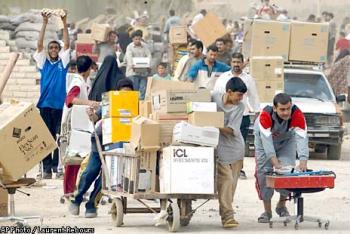
Indeed, although we are protected by not one but two audit bodies in the shape of the NAO and Audit Commission, parallels with the aftermath of Iraq in 2003 are quite promising. And here I would draw your attention to Rajiv Chandrasekaran's account of Imperial Life in the Emerald City
One gets the feeling that back in these safe shores we've seen a fair few shytery Custer Battles type outfits in the consultancy and outsourcing industries palling up to win contracts that couldn't or shouldn't have been delivered. It's not the process of outsourcing that is largely at stake, but the need for the activity to be managed and ordered by or on behalf of the state in the first instance that has to be questioned.
Just think about everyone suddenly getting present to the post-Soham rationale for creating the Independent Safeguarding Authority...
Now the 'bonfire of quangos' has become such a lifeless trope promised by every contender to power. It simply never happens. The machine don't give a damn.
But with fiscal deficit looming, Whitehall delaying all it can until safely in pre-election purdah maybe there is some hope.
If only the people of this country could be liberated to smash, take back or destroy the wasteful apparatus of state machinery, in the wilful spirit of the liberated Iraqi people in spring 2003.
Do you think what I'm thinking?
Subscribe to:
Posts (Atom)